Data Recovery Services On SSD, Not So Easy!
Read Time:2 Minute, 43 Second
Solid-state drives (SSDs) have become increasingly popular due to their superior performance, faster boot times, and increased reliability. Unlike traditional hard disk drives (HDDs), which use rotating platters and magnetic surfaces, SSDs rely on non-volatile storage chips, similar to those found in USB flash drives. While SSDs offer remarkable benefits, recovering data from them is far more complex than recovering data from an HDD.
The Advantages of SSDs
SSDs have several key advantages over traditional HDDs:
- Speed: SSDs can read data at speeds ranging from 300 MB/s for entry-level models to 3000 MB/s for high-performance ones, vastly outperforming HDDs, which typically read at 50 to 100 MB/s.
- Energy Efficiency: SSDs consume significantly less power compared to HDDs.
- Durability: Without any moving parts, SSDs are much more resistant to physical shocks, making them more reliable, especially in portable devices.
- Size and Noise: SSDs are smaller (usually 2.5 inches) and operate silently, unlike their mechanical counterparts.
However, despite these advantages, data recovery from an SSD is much more complicated.
The Challenge of Data Recovery from SSDs
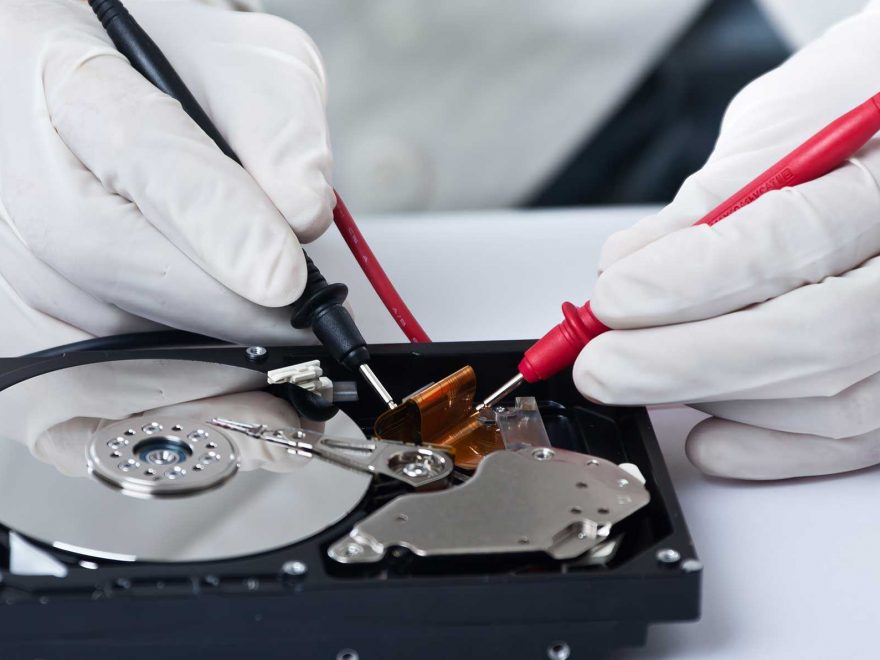
Unlike traditional hard drives, which have spinning disks and easily identifiable failure modes, SSDs store data in flash memory chips. When an SSD fails, especially due to an electronic failure or a small overvoltage during operation, data recovery can become a painstaking process. The process is more difficult because the data isn’t stored on physical, rotating platters but across multiple interconnected memory chips.
Here’s why data recovery from an SSD is much harder:
- Multiple Flash Chips: An SSD typically has several flash memory chips, often up to 8 or 16, depending on the size of the drive (e.g., 128 GB drive). Each chip must be unsoldered carefully using infrared techniques before data recovery can even begin.
- RAID-like Configuration: Recovery specialists need to figure out the interleaving of these chips, which can be a tricky process, especially in cases where the SSD operates in a RAID-like configuration. It’s like solving a puzzle, where the order of chips in the array must be reconstructed.
Is SSD Data Recovery Cheaper?
While the idea of no moving parts in SSDs might suggest that data recovery is simpler and more affordable, the reality is quite the opposite. Recovering data from SSDs requires advanced engineering and specialized tools, making it much more expensive and time-consuming. The process can be highly labor-intensive, requiring detailed attention to each individual chip, which adds to the complexity and cost.
Conclusion
While SSDs offer speed, reliability, and durability, they present significant challenges when it comes to data recovery. If you’re experiencing issues with an SSD, it’s crucial to seek professional help immediately to prevent further damage. Data recovery from SSDs involves advanced techniques, and the process can be both intricate and costly, especially if the failure is electronic or involves complex configurations like RAID arrays.
In short, while SSDs are excellent storage devices, their recovery process is anything but straightforward. When in doubt, it’s always best to consult a professional data recovery service to ensure the best chance of retrieving your lost data.


Happy
0 %

Sad
0 %

Excited
0 %

Sleepy
0 %

Angry
0 %

Surprise
0 %
 0
0
 0
0